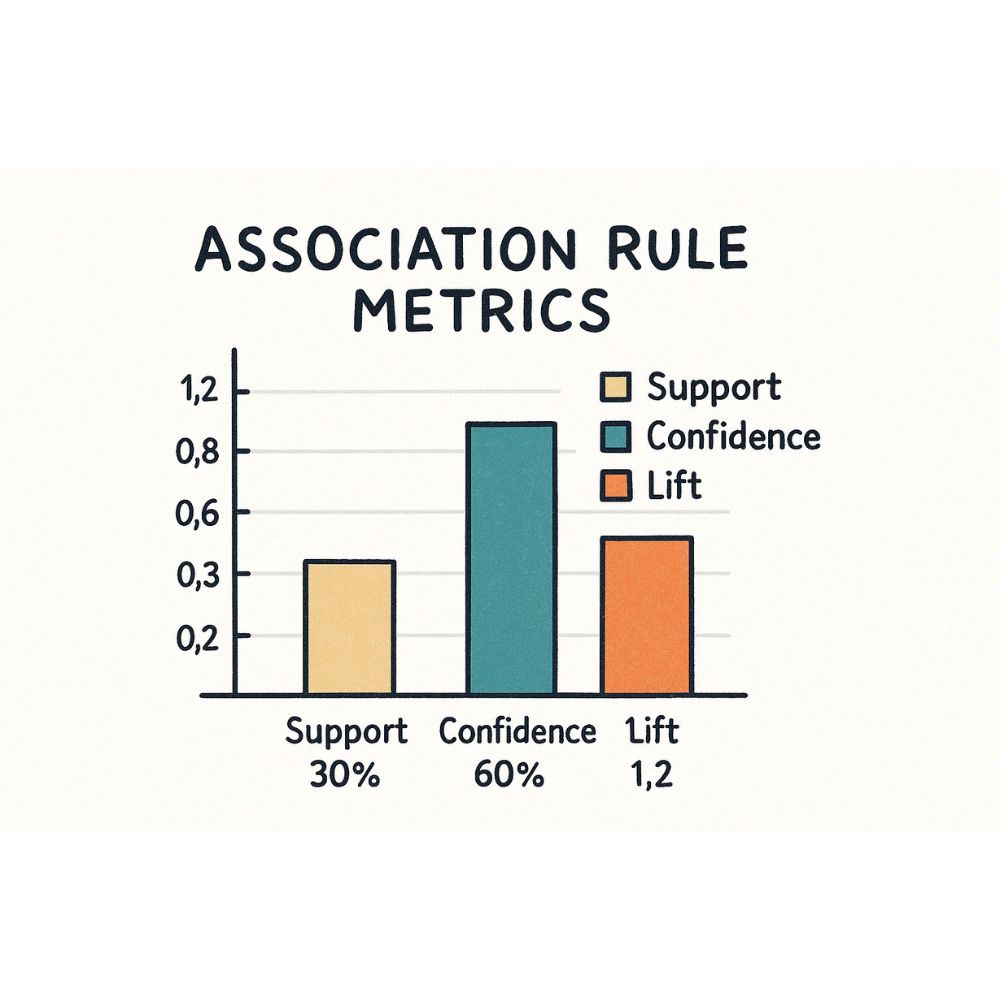
Market Basket Analysis (MBA) is a practical way to understand which products tend to be purchased together in real transactions. Retailers, e-commerce teams, and category managers use it to improve cross-sell recommendations, optimise store layout, design bundles, and plan promotions. The core idea is simple: if customers often buy item A and item B in the same basket, that relationship might be useful. But frequency alone can mislead, popular items co-occur with many things just because they are common.
That is where the lift metric matters. Lift helps quantify whether the presence of one item truly increases the probability of another purchase beyond random chance. For learners exploring analytics concepts through data analytics courses in Hyderabad, lift is one of the cleanest examples of how statistics turns raw co-occurrence into a meaningful signal.
What Market Basket Analysis actually measures
MBA is usually implemented through association rules such as:
- If a basket contains A, it is more likely to contain B.
To evaluate such rules, three common metrics are used:
Support
Support measures how often an itemset appears in all transactions.
- Support(A, B) = P(A ∩ B)
High support means the combination is frequent, which is useful for business impact. A rule that appears in only a handful of baskets may not be reliable or actionable.
Confidence
Confidence measures how often B appears when A appears.
- Confidence(A → B) = P(B | A)
Confidence can still be inflated by very popular items. For example, if B is purchased by most customers anyway, confidence may look high even if A does not “cause” B.
Lift: the metric that corrects for popularity bias
Lift compares the observed co-occurrence of A and B against what would be expected if they were independent.
- Lift(A → B) = P(A ∩ B) / (P(A) × P(B))
Equivalently: - Lift(A → B) = Confidence(A → B) / P(B)
How to interpret lift
- Lift = 1: A and B occur together about as often as expected by chance (no association).
- Lift > 1: B is more likely when A is present (positive association).
- Lift < 1: B is less likely when A is present (negative association).
A small numeric example
Suppose in your transaction data:
- P(A) = 0.20 (20% of baskets contain A)
- P(B) = 0.10 (10% of baskets contain B)
- P(A ∩ B) = 0.04 (4% of baskets contain both)
Then:
Lift = 0.04 / (0.20 × 0.10) = 0.04 / 0.02 = 2.0
A lift of 2.0 means the presence of A doubles the likelihood of B compared to random chance, this is the kind of relationship MBA aims to surface.
A practical workflow for Market Basket Analysis
Step 1: Prepare transaction data correctly
MBA needs data in a “basket” format: each transaction ID with a list of items purchased. Common preparation steps include:
- Cleaning product names/SKUs (avoid duplicates caused by inconsistent naming)
- Removing returns/cancellations (or treating them carefully)
- Deciding granularity (SKU vs brand vs category)
- Handling time windows (weekly vs monthly baskets can change patterns)
Step 2: Generate frequent itemsets
Popular algorithms include Apriori and FP-Growth. Both aim to find item combinations that appear frequently enough (above a support threshold). FP-Growth is often faster for large datasets.
Step 3: Create rules and filter them
You typically set thresholds like:
- Minimum support (to avoid tiny, unreliable rules)
- Minimum confidence (to ensure conditional relevance)
- Minimum lift (to ensure association beyond chance)
A good practice is to start with moderate thresholds, inspect results, and then tighten them to reduce noise.
Common pitfalls when using lift (and how to avoid them)
1) High lift with low support
A rare combination can produce a very high lift simply due to small counts. Always review lift alongside support. Rules with tiny support may not be stable.
2) Confounding factors like promotions or seasonality
Lift does not automatically account for context. A festival discount, a payday spike, or a limited-time bundle can create temporary associations. Consider segmenting by time period, store location, or campaign flags.
3) Substitutes vs complements
A negative association (lift < 1) can be just as useful. It may indicate substitutes (e.g., two competing brands). This can inform assortment planning and recommendation logic (“don’t recommend both together”).
4) “Actionability” matters more than the metric
Even a strong lift may not be useful if margin is low, inventory is constrained, or the pairing is obvious. Treat lift as a ranking signal, not the final decision.
Turning lift insights into business actions
Lift-driven rules can be applied in several ways:
- Cross-sell widgets: recommend B when A is in the cart
- Bundle design: create value packs for high-lift pairs with decent support
- Store layout: place complementary items closer (when it makes operational sense)
- Targeted offers: trigger coupons for B when A is purchased, but validate with A/B testing
- Inventory planning: anticipate linked demand to reduce stockouts
Teams learning how to connect analysis to operations in data analytics courses in Hyderabad often find MBA useful because it produces results that are easy to communicate, especially when you present lift, support, and confidence together.
Conclusion
Market Basket Analysis becomes far more reliable when lift is used to separate true associations from co-occurrences driven by item popularity. Lift answers a practical question: “Does buying A genuinely increase the chance of buying B beyond what we would expect anyway?” The best implementations combine lift with sensible support thresholds, time-based checks, and business context. When used carefully, lift-based rules can improve recommendations, bundle strategy, and merchandising decisions while keeping the analysis grounded in measurable, repeatable signals, exactly the kind of applied reasoning emphasised in data analytics courses in Hyderabad.
About the Author